
Why this concept performs structurally and why a VAWT‑based floating array is worth considering
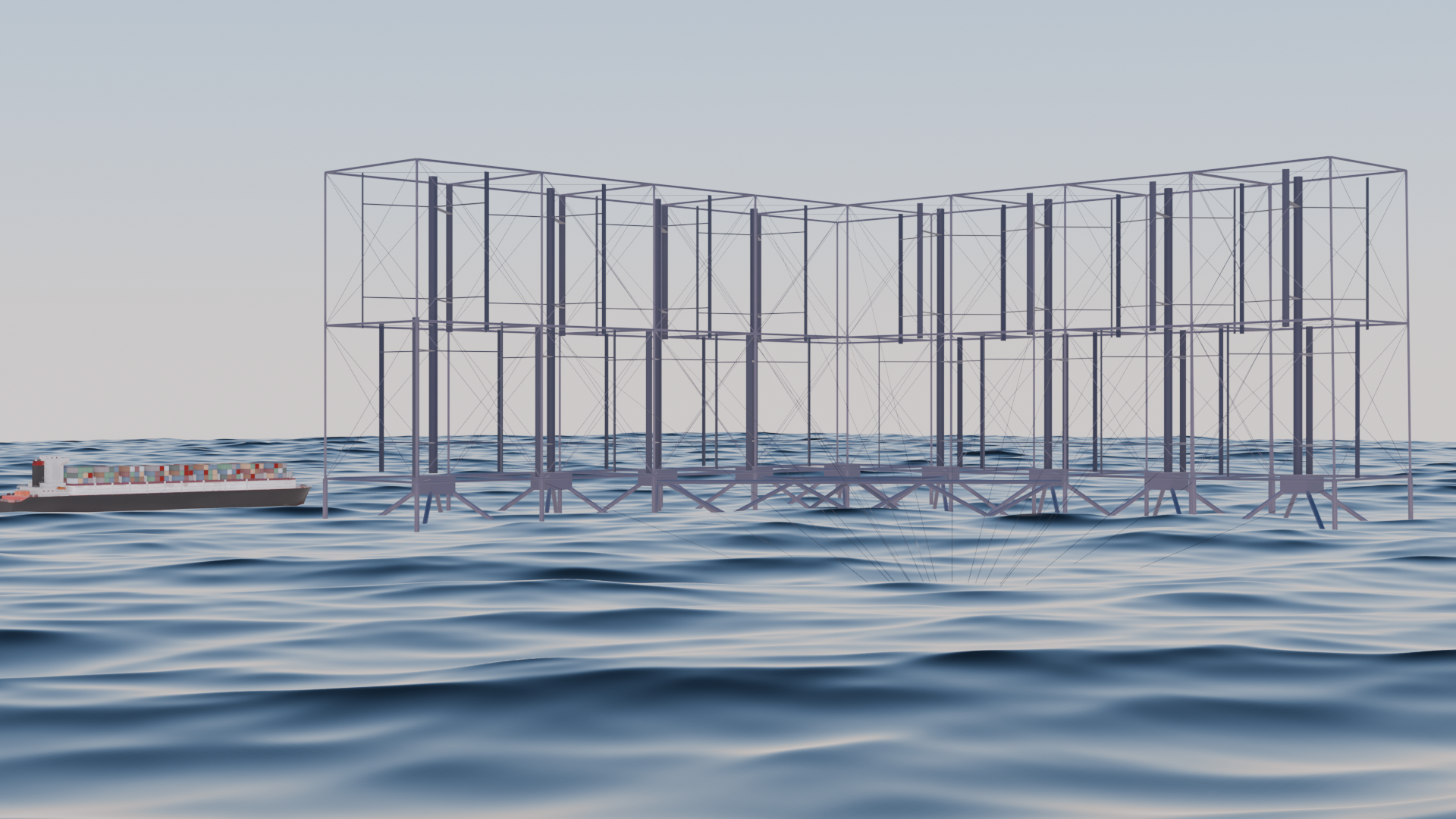
To validate the cube‑framed, stackable H‑type vertical‑axis architecture, three analyses were run against the NREL 5 MW Reference Wind Turbine, a widely used benchmark.
1. One Frame (5 MW)
A single H‑type VAWT rotor with its cube frame, sized to produce 5 MW at the rated wind speed. The swept area was the swept area of the NREL turbine plus 20%, plus a small margin.
2. Two stacked frames (2.5 MW each)
Two stacked H‑type VAWT frames on a common shaft, each producing 2.5 MW, for a total of 5 MW. The swept area was the swept area of the NREL turbine plus 20%, plus a small margin.
3. Three stacked frames (1.6 MW each)
Three stacked H‑type VAWT frames on a common shaft, each producing 1.6 MW, for a total of 5 MW. The swept area was the swept area of the NREL turbine plus 20%, plus a small margin.
Furthermore:
The top of the 3 stacked frames was higher than the top of the NREL turbine blades, giving access to higher‑altitude winds.
The total weight in all 3 cases of the cube frames was less than the weight of the NREL tower.
This shows that cube‑framed, stackable VAWT structures can be both lighter and reach higher than an equivalent HAWT tower for the same power rating.
Why a 20% larger swept area is used
A widely used comparison point is the coefficient of power (Cp):
HAWTs: roughly 50%
VAWTs: roughly 40–42%
To produce the same rated power at the same wind speed, a VAWT must sweep more area. Across the three analyses, a swept area 20% larger than the NREL turbine was used to compensate for the lower Cp of the VAWT. The same approach was applied to the floating 80 MW array, with a small additional margin for clearance between rotors and frames.
Thrust force: where the design point comes from
The NREL 5 MW turbine has a rated full‑power thrust of roughly 800 kN, but its tower does not fail until the thrust force is increased to about 2,890 kN. Instead of designing only at the rated wind condition, the cube frames were sized to survive up to this higher force level. This gives a conservative structural design point for the rotors and frames.
For the floating 80 MW array, the same sizing logic is used, but with a higher design thrust of about 4,330 kN to account for the additional loading that can occur because of platform accelerations due to ocean motion.
Land‑based beams: identical, worst‑case sized
On the land‑based, cube‑framed turbines:
The frames are fixed but the wind can come from any direction.
For this reason, all beams at a given level are sized to withstand the highest calculated force that can occur at that level, regardless of wind direction.
The result is a uniform, worst‑case‑sized frame at each level.
Floating turbine: directional optimization
On the floating 80 MW array, the situation changes:
The V‑array is designed to always face into the wind via the tether and pivot system.
Because the direction is known, beams and members that experience lower stress for the dominant wind direction can be made smaller.
This keeps the same safety philosophy as the land‑based design, while reducing material in members that are not at the worst‑case orientation.
How this fits into the floating array
Putting it together, the floating array concept is:
More than 4× the capacity of typical single‑turbine floating units.
Built from cube frames and pyramid struts that use the same structural rules proven in the land‑based analyses.
Sized against a higher thrust force to remain conservative under ocean motion.
Able to use smaller, lighter members where the structure is not in the worst‑case wind direction, because the V‑array stays oriented into the wind.
The conclusion from these analyses is that a cube‑framed, stackable VAWT architecture can be lighter, reach higher, and survive higher loads than the equivalent NREL HAWT benchmark, while the floating array extends that logic to a much larger platform.